
Презентація "Taras Shevchenko"


Taras Shevchenko1814-1861


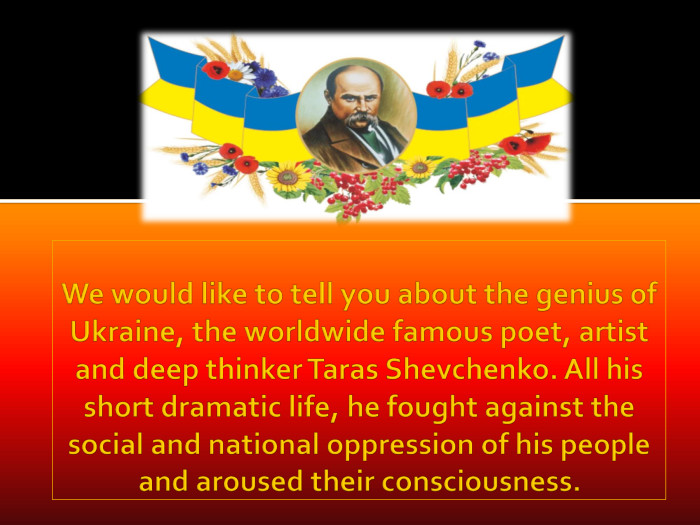
We would like to tell you about the genius of Ukraine, the worldwide famous poet, artist and deep thinker Taras Shevchenko. All his short dramatic life, he fought against the social and national oppression of his people and aroused their consciousness.

He was born into the family of a serf peasant in the village of Morintsi. In his childhood, he took a great interest in drawing pictures and writing poems.

When Taras was 14 years old, his master took him as a house-lackey to Vilno (Vilnius). Here, he heard a foreign speech for the first time in his life.

Later, Taras’s master took him to Petersburg where Karl Bruillow, a Russian artist, noticed his talent and bought him out of serfdom. Shevchenko studied at St. Petersburg Academy of Arts (1839-1845). When it comes to Ukrainian Art, Taras Shevchenko is considered to be a representative of romanticism and critical realism. As an artist, he was a good portrait-painter. He painted some of his self- portraits, portraits of actor Shchepkin, Haldridge, Maximovych – the Ukrainian scientist and first rector of Kyiv University.

However, his main calling was poetry. He wrote his poems in Ukrainian and his prose both in Ukrainian and in Russian. In 1840 he published his first book “Kobzar” and a year later – ‘Haidamaky’, a historical poem about the heroic struggle of the Ukrainian peasants against the Polish lords in 1768

In 1844 the poet wrote his satirical poem ‘A dream’ for which Nicholas I exiled him to the Kazakh steppes to serve as a private in the army.

His friends helped Taras Shevchenko to return from exile only in 1857. He resumed work at the Academy and continued to write. However, 10 years of exile had ruined his health and on March 10, 1861 Taras Shevchenko passed away. The poet’s grave, as he willed, is on a high Dnipro bank in Kaniv, not far from the village where he was born.

To honour the memory of this great man of Ukraine, a monument to Taras Shevchenko was erected not only in our Ukraine, but also in other cities throughout the world.

Monumental Shevchenkiana in the World. There are more than 450 monuments to Taras Shevchenko around the world.

Italy. There is really a small patch of Ukraine on the outskirts of the eternal city, Rome, where the golden domes of St. Sophia's Cathedral are glittering in the sun, and a modest building of Ukrainian Catholic university attracts a lot of young people to study theology and philosophy; and near-by rises the monument to Taras Shevchenko. It is really impressive and original. Every one who comes to see it is spell-bound by its grandeur and beauty.

France. Paris. In the very centre of Paris there is a small public garden named after Taras Shevchenko. The garden boasts Ukrainian St. Volodymyr's church and the bust of T Shevchenko. Shalette-sur-Loing. The bust of Taras Shevchenko adorns a small square in the town of Shalette. It is cast in bronze and the base is of granite. The Shevchenko monument was set up in 1974. A representative delegation from Ukraine took part in the unveiling ceremony. They brought a handful of soil from T. Shevchenko's grave in Kaniv and scattered it all around the monument. Nearby they planted willow sprouts of the Poet's willow in Khazakhstan.

Poland Bialy Bor (Білий Бір)In Poland the monument to Taras Shevchenko is situated in Bialy Bor in the west of the country. It was set up on September 22, 1991 and built up with the money raised by Ukrainians from all over the world. It is no ordinary monument, rather a monumental composition: there is a spherical mound crowned with the Cossack style cross and the upper part of it contains the bust of Taras Shevchenko. There is a bandura on the background of the cross. Taras Shevchenko is represented as a great national poet. It bears the following inscription carved on the bronze stand (it is written both in Ukrainian and Polish):«І на оновленій землі Врага не буде, супостата, А буде син, і буде мати, І будуть люде на землі.»The sculptor of the monument is V. Borodai, the architest is A. Ihnashchenko. The Shevchenko monument stands opposite the Ukrainian boarding school which has been raised to the status of Lyceum and it bears the Poet’s name.

Canada. The first monument to Taras Shevchenko on the American continent was set up in Palermo (Canada) on the 30th of June, 1951. It is a gift of Ukraine. The statue of the Poet is made of bronze and it is in full length. Nearly 45, 000 people took part in the unveiling ceremony. There is also the monument to Taras Shevchenko , which was built up in 1961, in Winnepeg (the capital of the province of Manitoba). The sculptor is Andriy Drahan from New York. The statue of the Poet is made of bronze, and we can notice the following Shevchenko’s words on the pedestal: «А на сторожі коло їх поставлю слово». T. Shevchenko is featured with the book open on his knees; he is deep in thought, his look is rather nostalgic: the Poet seems to be contemplating on the destiny of his beloved Ukraine. Toronto (Ontario province). The monument to T. Shevchenko was set up in 1961.

USA USA Washington The monument to Taras Shevchenko dominates the central part of the American capital. It was unveiled on June 26, 1964 which was a jubilee year – the 150th anniversary of the Poet’s birth. The world-famous sculptor Leo Moll (Leonid Molodozhanyn) is the author of this monument. The statue of the Great Poet is made of bronze and its pedestal is in granite. Leo Moll represented T. Shevchenko as a young man, full of vigour and thought. There were about 100,000 Ukrainians who participated in the unveiling ceremony. They came from all parts of the Ukrainian diaspora in the world. The former president of the USA Dwight Eisenhower made a speech in which he concentrated on Shevchenko’s freedom-loving ideas. The unveiling ceremony turned out to be a great national event of the Ukrainian people. The monument to T. Shevchenko in Washington appears to be the first remarkable work of monumental Shevchenko in the world.

Brasil. Taras Shevchenko in Brazil under a hot tropical sky! He gathered all Brazilian Ukrainians into a single whole.120 bandura-players participated in the Taras Shevchenko gala concert. It was a very great event in the life of the Ukrainian diaspora in Brazil. There is a small monument to T. Shevchenko in Curitiba, capital of Parana.

Argentina. Buenos Aires. The monument to Taras Shevchenko was set up in the centre of Buenos Aires on December 5, 1971. The sculptor Leo Moll shows the Poet at his young age. The base is made of pink granite and the statue is in dark bronze. The stele that attaches the Shevchenko monument has a bas-relief featuring «Haidamaky». Haidamaky rose in rebellion against the oppressors of Ukraine. They had a hot rebellious temper, and so are most Argentinians, hot-tempered.

Kazakhstan. The Fort of Shevchenko. The town is situated on the Mangyshlak Peninsula on the Caspian Sea. Once it used to be a small military settlement - the Novopetrovsk Fortress, where Taras Shevchenko was in exile for seven years (1850-1857). He went through the tough time and bitter years of his suffering. His health broke, but not his spirit. The Poet expressed it in such lines: “I'm tormented, I suffer but I don’ t repent”In 1850 T. Shevchenko and his Kazakh friend planted a willow-tree next to the fortress. The land is barren there but the willow-tree is still growing. Its sprouts have been planted in many places, even overseas. The place where the Poet dragged out his miserable existence has changed radically. It turned into a town, which was named after Taras Shevchenko. In 1932 the Shevchenko monument was set up there. There is the Taras Shevchenko Museum too. Only two exhibits have remained from Shevchenko's times: his sofa and a small mirror in a wooden frame. There is a very beautiful monument to Taras Shevchenko in the new city of Aktau. The Poet is featured in a sedentary position. The statue is made of bronze and the base is in granite. So Kazakhstan prides itself on two monuments to Taras Shevchenko.

Russia. Moscow The monument to Taras Shevchenko sprang up in Moskow in 1964. The high statue of the Poet is made of bronze and it stands on a huge piece of granite. It looks as if T. Shevchenko is going against the storm, he seems to be so resolute. Orsk is a town in Orenburgh Region, where T. Shevchenko was in exile. The monument to the Poet rises in Taras Shevchenko Square in the centre of the town. St. Petersburg. This 3-metre high, bronze monument was donated to the city of St. Petersburg by the Canadian sculptor Leo Mol. The monument was unveiled in Ordinary Garden near "Petrogradskaia" subway station in December 2000.

“ Love your Ukraine. Adore her in the difficult timesof evil,In the last terrible moment. Pray to God for her.”Taras Shevchenko

про публікацію авторської розробки
Додати розробку