
How to develop the skills of fast reading

HOW TO DEVELOP THE SKILLS OF FAST READING
To read properly, or, as the specialists put it, is a real art.
Practically everyone is able to master this art, but, unfortunately, not everybody can.
I offer you the material which may be interesting to our teachers and not only. I am sure it would be useful to our students, at least seniors ones, to get acquainted with this information too, because it can help them to increase their speed of reading not only in the English language, but also in the mother tongue and other languages if they study any.
Reading for the brain is as important as physical exercise for body.
Everyone can read, at least literate people can. But majority of people can’t rea properly. To be exact, these people do not know the rules of reading.
Nowadays modern people still read the same 150-200 words per minute, as it was a hundred or two hundred years ago. Does this mean that our resources are limited by the nature? Of course, not. It’s a fact of common knowledge, that 1\1000 of huge potential of human brain is used by a person. A lot of scientists set to work on this problem and tried to waken up the sleeping resources of our brain. They work out a unique system of teaching methods of fast reading. It’s not a kind of swift turning over the pages, not a ‘’diagonal skimming’’ but such fast reading of the text which guarantees and qualitative understanding. This team of scientist worked out the following rulers of fast reading.
Seven Rules of Fast Reading
1. Read the text only once.
2. Keep the Integral Algorithm of Reading.
3. Distinguish the dominance of the text.
4. Read without articulation.
5. Read the text using vertical moving of the eyes.
6. Be absolutely attentive.
7. Try to memorize the most important information.
It’s absolutely clear that these rules need some commentaries.
Rule 1. Any text of any difficulty should be read only once. Regression (eyes back moving to the previous passages of the test) is prohibited. Only after full reading and understanding of the plot is possible to re-read the text once more if it’s necessary. Some people got used to reading the text twice to be sure. But the effectiveness of such reading is very low. First of all, because it’s slow , second, because numerous comings destroy the distinct structure of the narration. This causes chaos and confusion in the reader’s head. One should get rid of this drawback once and for all. At first this will not be easy; at this stage remember that you may go back inwardly but without glancing at the text. Having read the passage, you should think over its content, try to recollect as many details as possible, and only after this you may continue your reading. After several days of training the necessity of re-reading will disappear.
Rule 2
Reading is based on the IAR(Integral Algorithm of Reading).You shouldn’t be afraid of the expression ‘’Integral Algorithm of Reading’’. The second rule can be formulated in a different ways: before opening a book, magazine or newspaper, decided for yourself clearly, which information you want to get. Then chaotic reading will become subordinate to the programmer-IAR. Let’s conditionally compare the programmers of two readers: the one who red slowly and another one who reds fast. The programmer of the latter will include 7 blocks:
_the title of the book;
-The author of the book;
_the source (newspaper or a magazine0
_ problem to with this book is devoted;
_facts, presented in the book;
_peculiarities of the presented material
_how new the material is and how it can be used in practical work.
To prove the effectiveness of IAR we may say that all the texts are overfilled with information which sometimes reaches 75 %. Practically only 25% of its volume carries the information for a reader. Thanks to IAR you’ll be able to extract the necessary information out of any text.
Rule 3 of fast reading is always to distinguish the dominance-the main content of the text. In every text there are words which ‘’push’’ you to continue reading: there are some which notify that there will be no changes in the content. There are other words which ‘’signal’’ about changes in the plot. Having learnt how to use such word-symbols, you ‘ll be able to distinguish between the most important and the least important information in the text.
The dominance of the text is distinguished step by step on the basis of key words which are connected in the plot lines. If you learn to find the dominance of the text while slow thoughtful reading, then in future you’ll be able to distinguish it automatically and instantly while fast reading.
Ruler 4 -reading without articulation. Most people have preserved the childish habit ‘’to pronounce’’ the text inwardly. Their tongue and lips are motionless, but studying this phenomenon showed that even literate people produce gullet movements while reading.
To learn how to read silently, we may recommend a special exercise. While reading a book or a newspaper, rhythm. You should tap on the hard surface, at the same spot with a pen clasped by three fingers, trying not to lose the rhythm. You should simple texts every day 1-1,5 hours tapping the rhythm. This must be done for a week. At first it will be difficult: you will lose the rhythm, sometimes you will not understand the information. But in an hour you will understand that it’s possible to read and to tap at the same time. In15-20 hours of doing exercise you will lose the habit of ’’pronunciation’’.
Rule 5 of fast reading is reading with vertical moving of eyes. For fast reading one should possess the wide, panoramic eyesight. You can develop it with the special tables. How does one of these tables look like?
It’s a square(20-20 cm) divided into 25 cells with digits from 1 to 25 written disorderly into them. There are 8 tables. It’s not very difficult to make such tables on your own.
You should use these 8 tables. Your task is to concentrate your eyesight in the middle of the table, see the whole of it and find all visible digits in order for more than 25 seconds. If you do the exercise correctly, with the time you
Will be able to embrace the whole table, and it means the whole page of any printed text.
Rule 6-To be absolutely attentive during reading. Not to get distracted isn’t an easy task. To be able to concentrate on the plot, you should constantly train your attention with the help of special exercises. Here are 2 of them.
Exercise ‘’Fingers’’
Sit comfortably in the armchair or on the chair, put your hands with clasped fingers on the knees. Mind: your thumbs must be free. Start revolving your fingers one around another with the constant speed, paying attention that they don’t touch each other. Concentrate your attention on this movement. This exercise should be done for 5 minutes during the first two weeks, then- 10 minutes, then 15. Once you will find out that you forgot about the instructions: your fingers are moving, your eyes are following the cloud in the sky and your thoughts are busy with guite different things .You should make yourself overcome these difficulties and concentrate on the movement of your fingers again.
Exercise ‘’The hand of the watch’’.
This exercise must be done 2-3 times every day. For 3 minutes observe the movement of the second hand of the clock or the watch. At first the exercise will seem very difficult for you. Very soon will find that you are not following the movement of the hand and your thoughts are busy with guite different problems. Mind: your attention must be arrested by the moving hand of the watch.
Rule 7-constant training og memory. There is no use of reading fast and much if in a day or two you forget all the information. There exist a lot of special exercises and methods for training one’s memory. We shall devote a special article to this problems.
Practical advice for teachers and leaners
One of the most widely spread kinds of reading is gist reading. Its aim is to train learns to red fast. The quick tempo of reading increases its eggectiveness. While reading slowly the reader’s attention weakens and their understanding of the text changes for the worse. It’s paradoxical, but when reading fast, we understand more. Having learnt how to read fast, learners will be able to read more English texts in the process of their studing, and this will increase their knowledge of English language.
Compare: for the Ukrainian or the Russion languages the minimal reading speed is 120 words per minutes. For the English language the minimal reading speed is 180words per minute. The task of the reader is ti increase this lower level of reading speed.
Though gist reading occupies one of the important places in people’s activity, our English textbooks either do not pay much attention to this kind of work at all, or teach this kind of activity on a very limited quantity of material. But that’s not a serious problem because every teacher is able to organize this process very easily.
How to Keep up the Control of the Process
Gist reading must at a certain speed ( not slower than 180-190 words per minute.) That’s why a learner must control the speed of reading every text. There is a rational way of fixing reading speed and this will help to count reading time quickly. For this one must mark the time he\she began his or her reading of the text and the time he or she finished it. You may measure the reading time in minutes or in a seconds.
Every recording of the text must designed in the following way:
Text
372( number of words)
Reading speed: Determine your reading speed.
Time you finished reading-10.32
Time you began reading- 10.30
Reading tim:2 min=120 sec
Reading speed=Number of words x60 \time of reading in seconds=372 x 60\=180 words per minute
HERE are the abbreviations which may be used for setting records:
FT-finishing time
ST-starting time
RT-reading time
NoW- number of words
Wpm-words per minute
The formulae for determining the reading speed:
- FT-ST=RT(IN SECONDS0
- RS=(NoW X 60 sec):RT=.....wpm
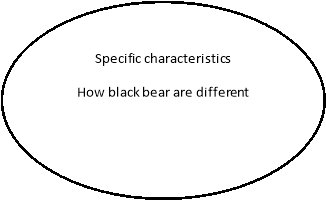
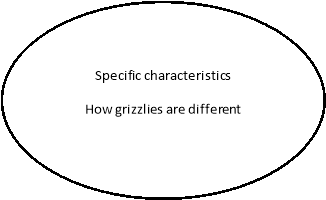
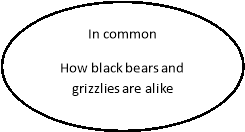
COMPARE AND CONTRAST
Venn Diagram
Specific characteristics
How grizzlies are different

Read the text
The kinds of bears found in North America are the black bear and the grizzly bear. Both of these bears are still found in the forests.
Both bears are good at smelling and fearing. Their small eyes see poorly. Both black bears and grizzlies are meat eaters. But the bears also feed on fruits, nuts, acorns, and the leaves and roots of plants. The long fur on bears protect them from bees. They need this help when they open beehives to eat honey.
There are many more black bears than grizzlies. The black bear seems to be happy in zoos. This bears is called clown of the woods. Because does tricks such as dancing or begging for rood. Black bears are fast runners and good tree climbers. Even though black bears are shy, they can dangerous. They should never be teased.
The grizzly bear is really dangerous animal. Many hunters call the grizzly the most dangerous North American wild animal. The grizzly is large and heavy. It almost never climbs trees.
Black bears sleep through most of the winter. Grizzlies seem almost never sleep. They hunt day and night and in all kinds of weather. A grizzly weighs almost three times as much as a black bear.
- Tell how black bears and grizzlies are alike and how they are different. Write the letter ”G” if this information is only about the grizzly bear and the letter ‘B’ if this information refers only the black bears. Write both letters (GB) if information is true about both bears.
a. dances and begs for food.
b. found in North America.
c. shy.
d. the clown of the wood.
e. sleep through the winter.
f. heavier.
g. have good smelling and hearing.
h. good tree climber.
i. found wild in the wood.
J .meat eater.
k. sees poorly.
L .most dangerous North American animal.
- Using Venn Diagram find more similarities and differences in these two kinds bears.
- What new information about bears have you learned?

про публікацію авторської розробки
Додати розробку

 Зареєструватись за допомогою Google