
Модальні дієслова в англійській мові

MODAL VERBSIN ENGLISH

Auxiliary verbs that convey necessity, possibility, capacity, permission, or obligation are known as modal verbs. Can, could, may, might, must, must, should, will, and would are examples of common modal verbs. They come before the main verb's base form without the prefix "to."WHAT ARE MODAL VERBS?

CAN is used to express general ability in the present or to ask for permission in informal situations. It shows that someone is capable of doing something right now or that something is possible. CAN / COULDCANEXAMPLES: COULDCOULD is the past form of "can," used to describe abilities someone had in the past. It is also a much more polite and formal way to make requests or offer suggestions in the present. EXAMPLES: I can speak English fluently. Can I borrow your pen for a minute?You can find great deals in this shop. I could swim when I was only five years old.. Could you please help me with this task?We could go to the cinema if you are free.
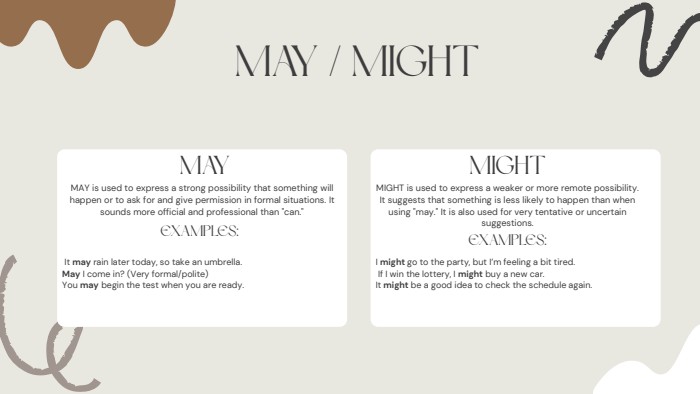
MAY is used to express a strong possibility that something will happen or to ask for and give permission in formal situations. It sounds more official and professional than "can."MAY / MIGHTMAYEXAMPLES: MIGHTMIGHT is used to express a weaker or more remote possibility. It suggests that something is less likely to happen than when using "may." It is also used for very tentative or uncertain suggestions. EXAMPLES: It may rain later today, so take an umbrella. May I come in? (Very formal/polite)You may begin the test when you are ready. I might go to the party, but I’m feeling a bit tired. If I win the lottery, I might buy a new car. It might be a good idea to check the schedule again.
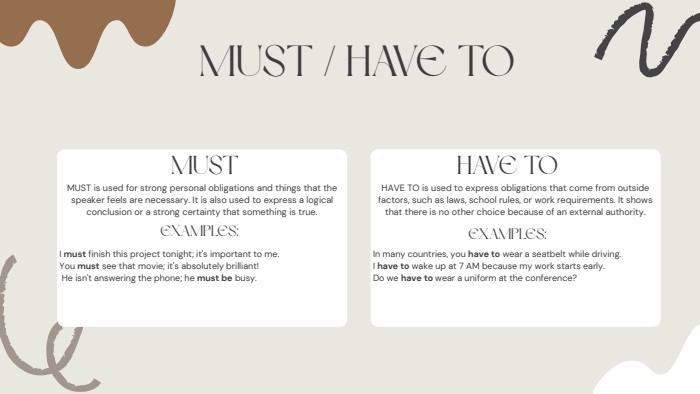
MUST is used for strong personal obligations and things that the speaker feels are necessary. It is also used to express a logical conclusion or a strong certainty that something is true. MUST / HAVE TOMUSTEXAMPLES: HAVE TOHAVE TO is used to express obligations that come from outside factors, such as laws, school rules, or work requirements. It shows that there is no other choice because of an external authority. EXAMPLES: I must finish this project tonight; it's important to me. You must see that movie; it's absolutely brilliant! He isn't answering the phone; he must be busy. In many countries, you have to wear a seatbelt while driving. I have to wake up at 7 AM because my work starts early. Do we have to wear a uniform at the conference?
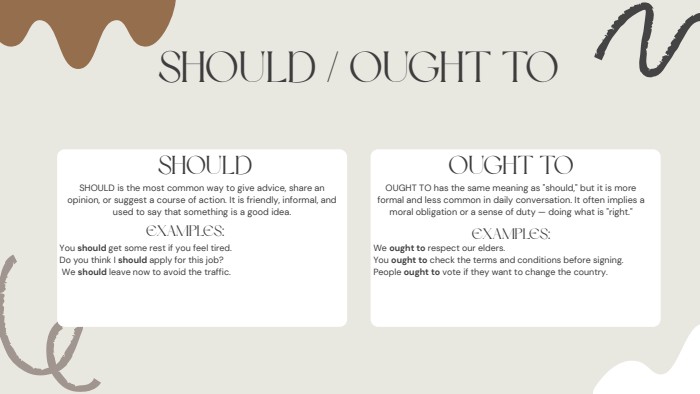
SHOULD is the most common way to give advice, share an opinion, or suggest a course of action. It is friendly, informal, and used to say that something is a good idea. SHOULD / OUGHT TOSHOULDEXAMPLES: OUGHT TOOUGHT TO has the same meaning as "should," but it is more formal and less common in daily conversation. It often implies a moral obligation or a sense of duty — doing what is "right."EXAMPLES: You should get some rest if you feel tired. Do you think I should apply for this job? We should leave now to avoid the traffic. We ought to respect our elders. You ought to check the terms and conditions before signing. People ought to vote if they want to change the country.
TASKS
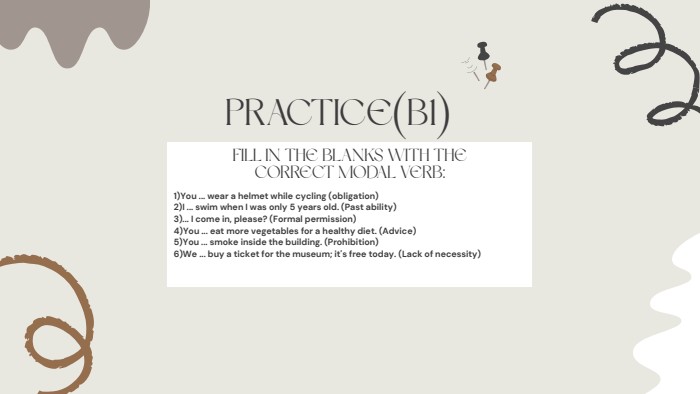
PRACTICE(B1)FILL IN THE BLANKS WITH THE CORRECT MODAL VERB:1)You ... wear a helmet while cycling (obligation)2)I ... swim when I was only 5 years old. (Past ability)3)... I come in, please? (Formal permission)4)You ... eat more vegetables for a healthy diet. (Advice)5)You ... smoke inside the building. (Prohibition)6)We ... buy a ticket for the museum; it's free today. (Lack of necessity)
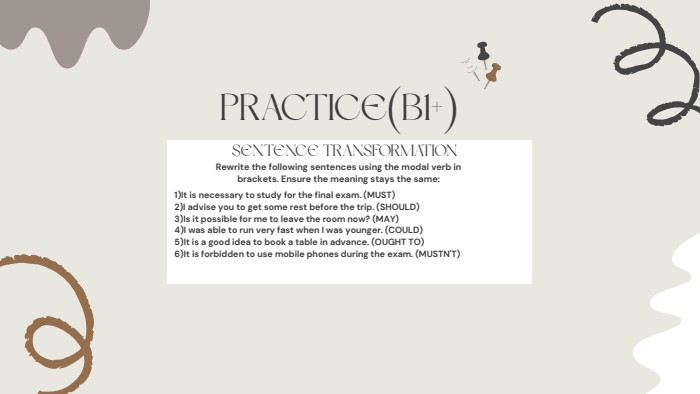
PRACTICE(B1+)SENTENCE TRANSFORMATIONRewrite the following sentences using the modal verb in brackets. Ensure the meaning stays the same:1)It is necessary to study for the final exam. (MUST)2)I advise you to get some rest before the trip. (SHOULD)3)Is it possible for me to leave the room now? (MAY)4)I was able to run very fast when I was younger. (COULD)5)It is a good idea to book a table in advance. (OUGHT TO)6)It is forbidden to use mobile phones during the exam. (MUSTN'T)
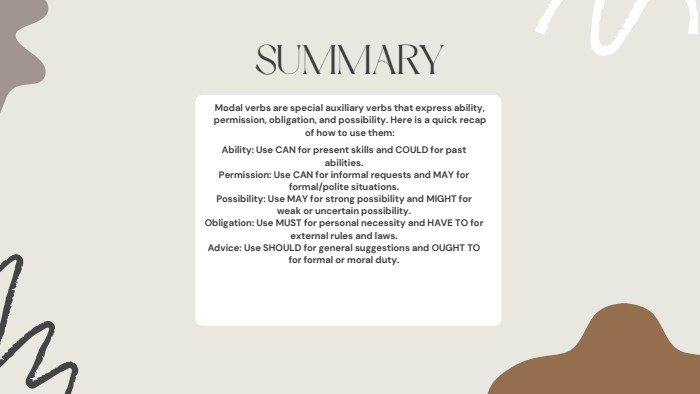
SUMMARYModal verbs are special auxiliary verbs that express ability, permission, obligation, and possibility. Here is a quick recap of how to use them: Ability: Use CAN for present skills and COULD for past abilities. Permission: Use CAN for informal requests and MAY for formal/polite situations. Possibility: Use MAY for strong possibility and MIGHT for weak or uncertain possibility. Obligation: Use MUST for personal necessity and HAVE TO for external rules and laws. Advice: Use SHOULD for general suggestions and OUGHT TO for formal or moral duty.
про публікацію авторської розробки
Додати розробку
 Зареєструватись за допомогою Google