
Урок-гра "Мій день. The Past Simple Tense"
Про матеріал
Урок-гра з англійської мови для учнів 3 класу загальноосвітнього навчального закладуУрок-гра з англійської мови для учнів 3 класу
Тема. Мій день. The Past Simple Tense.
Мета. Практична: активізувати лексику з теми «Мій день»; удосконалювати фонетичні навички; розвивати техніку читання та перекладу; перевірити рівень засвоєння вивченого матеріалу за темою; вдосконалювати навички письма, говоріння, читання та аудіювання. Розвивати вміння вести бесіду за темою, формувати вміння монологічного мовлення.
Освітня і розвивальна: розвивати творчий потенціал учнів на основі користування узагальнення. Розвивати готовність до участі в іншомовному спілкуванні; формувати вміння учнів вживати в мові граматичні структури Past Simple.
Виховна: виховувати культуру спілкування, підвищувати інтерес до вивчення іноземної мови.
Обладнання. Тематичні картки, малюнки, підручник, папки з роздавальним матеріалом, кросворд, індивідуальні «сніжинки» із завданнями, наочний матеріал: будиночки, корзинка з квітами та бджоли із словами.
План уроку.
- Організація класу.
- Мовленнєва зарядка.
- Повідомлення теми уроку.
- Відтворення теоретичних відомостей, практичних навичок.
- Виконання вправ.
- Виставлення оцінок.
- Підсумки уроку і повідомлення домашнього завдання.
Хід уроку.
I. Starting point.
1. Greetings.
T: Good morning, dear children!
Ps: Good morning, good morning,
Good morning to you,
Good morning, good morning,
We are glad to see you!
T: How are you today?
P: I’m well. Thank you.
2. Warning up.
T: Who is on duty today?
P1: I am on duty today.
T: Who is absent?
P1: Nobody is.
T: What is the weather like today?
P2: The weather is cold like today.
T: What day is it today?
P2: It is Tuesday.
T: What day was it yesterday? Look at the calendar.
P1: It was Monday.
T: You are right. Were you at school yesterday?
P3: Yes, we were.
T: Then let’s sing about it.
Song.
The days of week
I was at school on Monday,
I was at school on Tuesday,
I was at school on Wednesday,
I was at school on Friday.
Refrain:
Let’s go to school
Let’s go to school
Let’s go to school together.
Let’s go to school
Let’s go to school
To learn to read and write.
We went to school on Monday,
We went to school on Tuesday,
We went to school on Wednesday,
We went to school on Friday.
T: Well done, children. Thank you.
II. Main part of the LESSON.
1. Introduction announcing the topic and the objectives.
T: That’s great. So, boys and girls. We have finished our topic and today I’d like to see how you understood Past Simple and how you used it in practice.
Наш урок буде сьогодні незвичайний. Ми помандруємо зараз у царство «Граматики». Тому на нас чекає багато перешкод, і, лише подолавши їх, ми зможемо досягнути його вершин.
Інсценізація казки.
З давніх-давен у царстві Граматики Англійської мови жили-були Дієслова. Деякі з них називалися Правильними. Вони усе любили робити за правилом. У минулому часі до них додавалося закінчення -ed. І одразу всім було зрозуміло, що це – дієслово минулого часу. А інші Дієслова не мали не мали закінчення -ed. Все в них виходило не так, як у Правильних, дуже оригінально. І за це такі дієслова почали називати Неправильними, адже ніяким правилам вони не підпорядковувались.
Одного разу між Правильними і Неправильними Дієсловами виникла серйозна суперечка.
- Дивіться, як зручно! – хвалилися правильні Дієслова. – Додав закінчення -ed – і ось вам форма минулого часу!
Особливо ж були задоволені дієслова to like – liked – подобатися, та to love – loved – любити.
- А у нас зате усі форми різні! – не поступалися дієслова to take – took - брати, to begin – began - починати, to do – did – робити, а також деякі інші.
- Усе у вас нудно, ніякого польоту фантазії. А у нас стільки різноманітності, що навіть не запам’ятаєш одразу! – раділи дієслова to fly – flew – літати та to draw – drew – малювати. – від цього в учнів стільки клопоту! Та нічого, зате ми й запам’ятовуємося краще.
- Ні, нас легше запам’ятати. Адже є правило, - не піддавалися Правильні дієслова. – А ви не підпорядковуєтеся жодним правилам, жодному порядку.
І довго б ще вони сперечалися, якби їх не примирив Минулий час.
- Усі ви однаково потрібні в мовленні, - пояснив він суперникам. – Правильні дієслова учень запам’ятає одразу, знаючи правило. А Неправильні … Нічого, пройде час, попрацює – і теж знатиме напам’ять. Не сваріться, будь-ласка, без вас аж ніяк не можна.
Так і примирилися Правильні і Неправильні Дієслова. Знають: не обходяться без них ті, хто вивчає англійську мову.
Отже, давайте й ми спробуємо показати, що ж ми знаємо.
Let’s start right now.
2.Vocabulary and grammar practice.
1) Training was/were.
T: Look! What a wonderful basket of flowers. But there are bees in it too. They want to fly home but they cannot do it themselves. Help them.
(The “bees” have the pronouns (he, she, it, we, they, you, I) on them. There are houses with the signs “was”, “were”. Two pupils have to put the bees into the right house.)
T: While the “bees” look for their house, let’s try to guess where were you yesterday I’d like one pupil to go out. All the rest look at the pictures and choose one (e.g. “school”).
(The pupil returns.)
P1: Were you at the cinema yesterday?
Cl: No, we were not.
P2: Were you at school yesterday?
Cl: Yes, we were.
T: And now I’d like someone to say where he was. And we shall guess the place.
P1: Yesterday was Wednesday. I was in a big house. My friends were there too.
Cl: You were at school.
P2: Yesterday was Monday. I was in Rivne. I was in the park. There were many animals.
Cl: You were at the zoo.
2) Training regular verbs.
T: Here is an obstacle again. You write down regular verbs in Past Simple without mistakes, of course. You have only 2 minutes. So, begin writing. Each member of team has to write only one verb.
3. Reading practice.
a) Read the sentences on page 114 and match. (ex.2, pp.113-114 SB)
(p1-p2-p3)
b) T: And now we must read the text.
My Day
I wake up in the morning and brush my teeth. Then I wash my face and get dressed. After that, I have breakfast. I go to school and learn new things. I read, write, and play with my friends. School is fun! After school, I go home and do my homework. Then I play outside or watch cartoons. In the evening, I have dinner with my family. After that, I take a shower and go to bed. I love my day!
- What do you usually do in the morning?
- What do you do at school?
- Do you watch cartoons in the evening?
T.: Let’s read the text “My day” and then answer the questions after it.
Find regular verbs in this text and write down them into your vocabularies. Then rewrite in the past.
(p1-p2-p3)
4. Контроль виконання домашнього завдання.
T: So, and how do you spend your day? It was your home task.
(1-2 учні розповідають про свій день.)
5. Speaking.
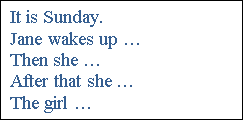
T: We’ll make the story about Jane’s day. You get a card with pictures that help you.
(див. додаток 1.)
6. Rest time.
T: Let’s sing the song “My day”.
My day
Breakfast in the morning,
Dinner in the day.
Tea comes after dinner
Then it’s time to play.
Supper in the evening
When the sky is red.
Then the day is over
And we go to bed.
(Учні співають пісню, виконуючи рухи.)
7. Listening comprehension and training regular and irregular verbs.
a) T: And now listen to the poem and find irregular verbs.
Say, said. Stop on red.
Eat, ate. Don’t be late!
Break, broke. Have a coke.
Take, took. Learn the cook.
Speak, spoke. Tell a joke.
Write, wrote. Get of the boat.
b) T: Let’s play “Hot potato”. (The teacher throws the ball and says a verb in Ukrainian. The children have to say it in English.)
Робити –
Говорити –
Давати –
Вставати –
Плескати –
Бачити –
Вдягатися –
Грати –
Іти –
8. Writing.
T: Your reading is nice. I know you like to write. If you want to be clever you must write correctly. Let’s remember the Past Simple Tense Form. Use Past Simple forms of the verbs in brackets. (On the cards)
1 variant
Перетвори речення у Past Simple.
- I (play) tennis in the yard.
- He (help) him father about the house.
- We (go) to the park on Mondays.
2 variant
Перетвори речення у Past Simple.
- I (wash) up in the morning.
- She (go) to school at 7 o’clock.
- They (clean) their home on Saturdays.
III. FINAL part of the lesson.
1. Crossword.
T: You have crossword on your desk and there is a big one on the blackboard. It helps us to remember the main words of our lesson.
- A time when we have breakfast. (morning)
- 24 hours. (day)
- A day when we rest. (Sunday)
- This thing where you put your books in your room. (table)
- This thing where you write your class work. (copybook)
 1
 2
3
 4
5
2. Home task.
T: Your home task for the next lesson is to write the composition “My friend’s day”.
3. Summing up.
T: Good job. Today at our English lesson we read, write, speak and sing songs about your day. Some of you were very active and got some ferries. What have we done? What did you like best of all?
Your marks are …
T: Good bye, children.
Ps: Good bye, good bye!
Good bye to you!
Bye-bye, bye-bye!
It’s nice to see you.
Додаток 1.


 Зареєструватись за допомогою Google