
Урок "Daily routines"

1
Daily Routines
Suggested level – A1 – Elementary

Objectives:
- to practise pronunciation;
- to activate vocabulary;
- to practise pupils’ speaking skills;
- to improve listening skills;
- to develop pupils’ language skills using interactive forms (group work, games);
- to develop pupils’ memory, logical thinking, quick reaction.
Equipment:
- a poster with a poem;
- a poster with time expressions (Present Simple);
- CD and CD player;
- Fly High 3 Fun Grammar;
- cards with phrases.
The Procedure:
I.Warm up.
1.The teacher reads a poem from the board. Pupils repeat after the teacher.
Every day I drink some tea,
But I never climb a tree.
I always try to help my mum,
In the park I sometimes run.
2.Pupils read the poem aloud.
3.T: Answer the question: What is the poem about?
( Sample answers : У вірші говориться про те, що дівчинка робить кожен день, завжди або ніколи.)
T: Ваша відповідь на моє питання і буде темою нашого уроку. Тобто, ми будемо говорити про речі, які ми виконуємо постійно або час від часу.
II. Phonetic Drill.
Listen and repeat. ( Fly High 3 Fun Grammar. Ex.1 , p. 12. Track 12.)
run watch play wash do look ride sing go eat
+ s + es
runs watches
T: Яке закінчення ми додавали до всіх прослуханих слів?
T: У яких випадках ми додаємо його?
III. Speaking. Practising affirmative sentences in Present Simple.
- Listen to the sentence and then tell that your friend also does this.
T: I swim in the river in summer.
P1: My friend swims in the river in summer.
( Pupils get cards with a list of phrases which will help them in making their sentences.)
- eat a lot of fruit;
- drink tea;
- run in the morning;
- jump in PT lesson;
- watch TV;
- play volleyball;
- read books;
- go to school;
- like chocolate;
- ride a bike
2. Look at the poster with time expressions and make sentences using them.
( On the poster pupils see time expressions we use with the Present Simple . Pupils also get a list of phrases to help them make sentences.)
- go to the park
- do the homework
- help my friend
- cook pizza
- play computer games
- ride a bike
- drink coffee
- rollerblade
e.g. I do my homework every day.
I never cook pizza.
IV. Listening.
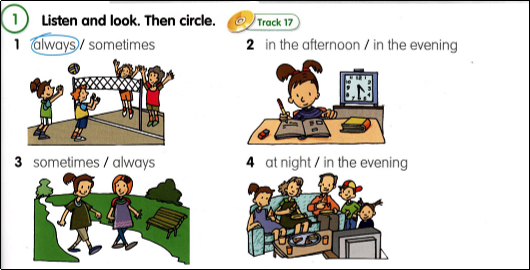
Listen and look .Then circle. ( Fly High 3 Fun Grammar. Ex. 1, p.17 Track 17 ).
V. Writing.
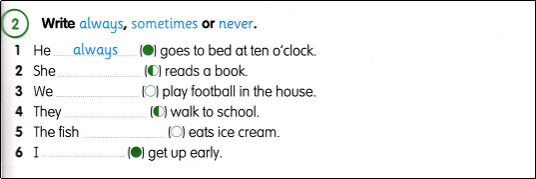
Write always, sometimes or never. ( Fun Grammar. Ex. 2, p.17 ).
VI. Speaking.
- Practising questions in Present Simple.
T: Answer the questions.
A) Teacher asks any questions with “Do”.
e.g. Do you watch TV in the morning / in the evening?
B) Teacher asks questions with “ Does”.
e.g. Does your mum read books every day?
- Practising negatives.
T: Say what you don’t do every day, in the morning, on Sunday, etc.
( Pupils make sentences using given possible phrases).
T: Say what your friend, cousin, sister doesn’t do.
( Pupils make sentences using given possible phrases).
VII.Pair work.
P1 asks questions about partner’s members of his family.
P2 gives answers.
VIII. Playing games.
1. Mime game.
P1 shows an action using Present Simple.
P2 guesses and makes a sentence.
2. Whisper game.
Pupils stand in a line and make a team. Teacher says a sentence to P1. P1 tries to repeat a sentence to P2. Then P2 says this sentence to P3, etc. Finally the last pupil of the team should repeat the whole sentence himself. Team 2 make the same. If the team repeat the sentence correctly, they are the winners.
( Sample sentence : Children sometimes go to the park on Sundays.)
IX. Homework.
T: Your homework for next lesson is to learn the poem that we read today at the lesson. As for your marks today, they are ………… They show that you were very active at the lesson. Good bye.
1
про публікацію авторської розробки
Додати розробку
 Зареєструватись за допомогою Google