
Art and Imagination. M. Pryimachenko

Art, Dualities, and Imagination. Mariya Pryimachenko
Warm-Up & Lead-In (10 Minutes)
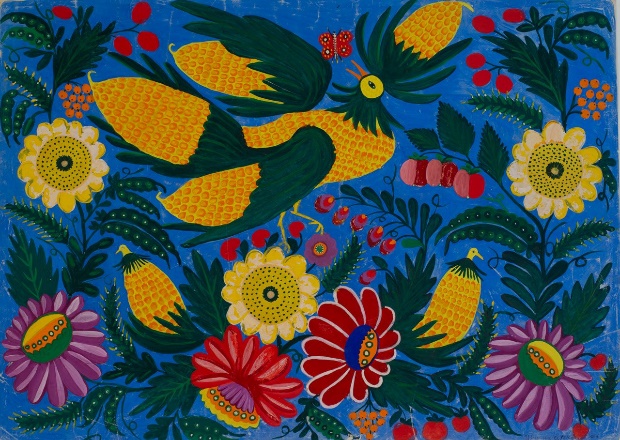
Discussion: Look at the image or think of a favorite painting. What kind of animals or colors do you prefer in artwork?
What comes to mind when you hear the phrase "fantastic beasts"? List 3 words to describe art that feels like a fairy tale.


Look closely at one of Maria Prymachenko’s artworks for 60 seconds. Then, close your eyes or cover the image. Describe everything you can remember (colors, shapes, background elements, animals).
Task 1: Vocabulary Matching
Match the word on the left with its correct definition on the right:
Word |
Definition |
1. Vibrant 2. Beast 3. Ambiguous 4. Triumph 5. Sorrow |
A. Not clear; having more than one possible meaning B. A feeling of deep sadness C. Bright, full of energy or color D. A large, wild, or mythical animal E. To win, succeed, or overcome a struggle
|
Student Worksheet Task 2: Gap Fill
Fill in the blanks using the vocabulary words above:
Vibrant
Beast
Ambiguous
Triumph
Sorrow
The painting uses __________ colors like bright yellow and orange to catch your eye.
The monster in the story had an __________ smile—you couldn't tell if it was kind or mean.
Her artwork shows that hope will always __________ over difficult times.
Section 2: Reading & Comprehension
Read the text
Maria Prymachenko was a famous Ukrainian artist known for her bright, fairy-tale-like paintings. It is very easy to fall in love with her vibrant colors, floral patterns, and imaginative details.
Great masters admired her work. Pablo Picasso said, "I bowed down before this artistic miracle of this brilliant Ukrainian." Marc Chagall also said that his own paintings were "cousins to the strange beasts of Maria Prymachenko."
Her art often combined opposite ideas: the ugly and the beautiful, or the predatory and the innocent. Many of her fantastic beasts are ambiguous, making it hard to identify them as purely good or evil. This reflected real life, which is both difficult and wonderful.
One of her favorite themes was the combination of joy and sorrow. For example, she painted graves surrounded by bright, blooming flowers. When people asked her why she painted strange beasts instead of real humans, she simply answered, "They are people." Despite having a hard life, she remained an optimist whose art celebrated light and hope.
Comprehension Questions:
What two famous artists were inspired by Maria Prymachenko's work?
What opposite qualities did Prymachenko combine in her paintings?
How did she represent the theme of "joy and sorrow" in her artwork?
What was her answer when asked why she didn't paint people?
Section 3: Grammar in Context — Reported Speech
Grammar Rules Focus:
When we report what someone said in the past, we usually step the verb back into the past tense:
Direct: "I love this art." → Reported: He said that he loved that art.
Direct: "My paintings are similar." → Reported: He said his paintings were similar.
Student Practice Tasks:
Rewrite Sentence A:
Direct Quote: Pablo Picasso said, "I bow down before this miracle."
Reported Speech: Pablo Picasso said that he ________________________ before that miracle.
Rewrite Sentence B:
Direct Quote: Marc Chagall said, "My paintings are cousins to these beasts."
Reported Speech: Marc Chagall said that his paintings ________________________ cousins to those beasts.
Rewrite Sentence C:
Direct Quote: Maria said, "They are people."
Reported Speech: Maria said that they ________________________ people.
Section 4: Wrap-Up & Speaking (10 Minutes)
Discussion Questions (Pairs or Small Groups):
Do you prefer art that is simple and happy, or art that combines joy and sorrow? Why?
If you drew a "fantastic beast" to represent your mood today, what colors and features would it have?
Complete Teacher Answer Key
Section 1: Vocabulary
Matching: 1-C, 2-D, 3-A, 4-E, 5-B
Gap Fill: 1. vibrant, 2. ambiguous, 3. triumph
Section 2: Reading Comprehension
Pablo Picasso and Marc Chagall.
She combined the ugly and the beautiful, the predatory and the innocent, and good and evil.
She painted graves surrounded by bright, blooming flowers.
She said, "They are people."
Section 3: Grammar
Sentence A: ...bowed down...
Sentence B: ...were...
Sentence C: ...were...


про публікацію авторської розробки
Додати розробку
 Зареєструватись за допомогою Google