
Презентація Passive Voice

Про матеріал
Презентація розрахована на 11 клас - підготовку до НМТ з англійської мови. Презентація містить теоретичну та практичну частину. Охоплює тему пасиву повністю
Англійська мова: Passive Voice

The Eiffel Tower is located in Paris, France. It was built by Gustave Eiffel in 1889. It was constructed with iron, not steel as it is widely believed. It is visited by millions of tourists every year. Англійська мова: Passive Voice. Form. We form the passive with the verb to be and the past participle of the main verb. The Passive

TO BE + V3/V + ed{5 C22544 A-7 EE6-4342-B048-85 BDC9 FD1 C3 A}Active. Passive. Present simple. He waters the plants twice a week. The plants are watered twice a week. Present continuous. He is watering the plants at the moment. The plants are being watered at the moment. Past simple. He watered the plants yesterday. The plants were watered yesterday. Past continuous. He was watering the plants at 10 o’clock yesterday morning. The plants were being watered at 10 o’clock yesterday morning. Future simple. He will water the plants tomorrow. The plants will be watered tomorrow. Present perfect. He has already watered the plants. The plants have already been watered. Past perfect. He had watered the plants by the time his wife came home. The plants had been watered by the time his wife came home. Future perfect. He will have watered the plants by 5 o’clock. The plants will have been watered by 5 o’clock. Modals. He must water the plants now. The plants must be watered now. Англійська мова: Passive Voice
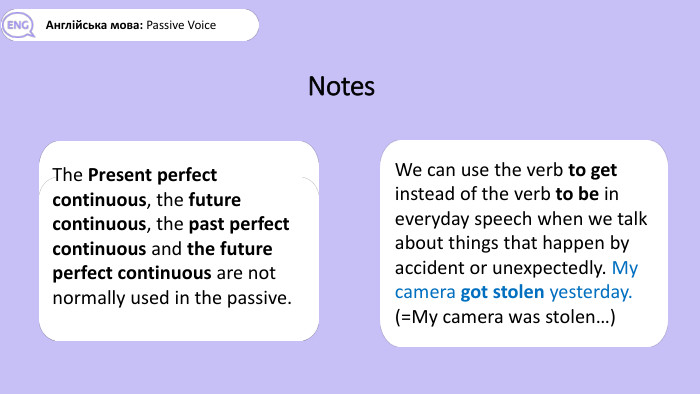
Notes The Present perfect continuous, the future continuous, the past perfect continuous and the future perfect continuous are not normally used in the passive. We can use the verb to get instead of the verb to be in everyday speech when we talk about things that happen by accident or unexpectedly. My camera got stolen yesterday.(=My camera was stolen…)Англійська мова: Passive Voice

Use.the person who carries out the action is unknown, unimportant or obvious from the context. We were robbed last week. (We do not know who robbed us.) Cars are made in Japan. (It is not important to know who makes the cars.) My car was repaired yesterday. ( It is obvious that a mechanic repaired the car.)The action itself is more important than the person who carries it out, as in news headlines, news reports, newspaper articles, formal notices, instructions, advertisements, processes, etc. The new museum will be opened by the Mayor. (news headline) The cocoa beans are roasted in giant ovens. (process) we want to sound more polite when we refer to an unpleasant or unfortunate event instead of referring to smb personally. My new vase has been broken. (more polite) Instead of “You have broken my new vase.” (it sounds rude)we want to emphasise the agent. The announcement was made by the Prime Minister. We use the passive when:
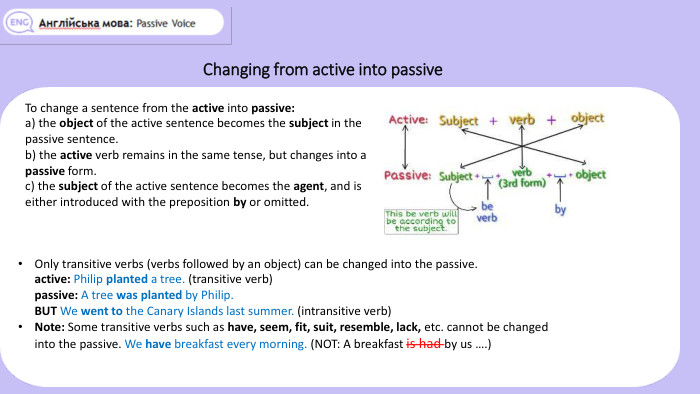
Changing from active into passive. To change a sentence from the active into passive:a) the object of the active sentence becomes the subject in the passive sentence.b) the active verb remains in the same tense, but changes into a passive form.c) the subject of the active sentence becomes the agent, and is either introduced with the preposition by or omitted. Only transitive verbs (verbs followed by an object) can be changed into the passive.active: Philip planted a tree. (transitive verb)passive: A tree was planted by Philip. BUT We went to the Canary Islands last summer. (intransitive verb)Note: Some transitive verbs such as have, seem, fit, suit, resemble, lack, etc. cannot be changed into the passive. We have breakfast every morning. (NOT: A breakfast is had by us ….)

we use by + agent to say who or what carries out the action. We use with + instrument/material/ingredient to say what the agent used. The apricot jam was made by Veronica. It was made with apricots and sugar. The agent is often omitted in the passive sentence when the subject of the active sentence is one of the following words: people, one, someone/somebody, they, he, etc.active: Someone has eaten the cake.passive: The cake has been eaten. BUT The agent is not omitted when it is a specific or important person or when it is essential to the meaning of the sentence.“Othello was written by William Shakespeare. BY VS WITH
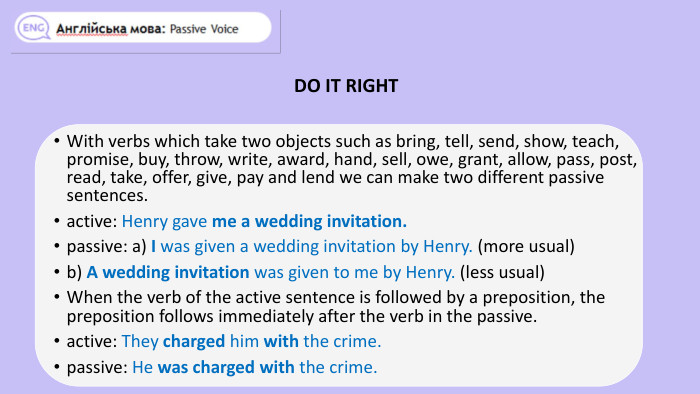
With verbs which take two objects such as bring, tell, send, show, teach, promise, buy, throw, write, award, hand, sell, owe, grant, allow, pass, post, read, take, offer, give, pay and lend we can make two different passive sentences.active: Henry gave me a wedding invitation.passive: a) I was given a wedding invitation by Henry. (more usual)b) A wedding invitation was given to me by Henry. (less usual)When the verb of the active sentence is followed by a preposition, the preposition follows immediately after the verb in the passive.active: They charged him with the crime.passive: He was charged with the crime. DO IT RIGHT

Questions in the passive. To ask questions in the passive, we invert the verb and the subject. Has he painted the fence yet? Has the fence been painted yet?When we want to find out who or what did something, then the passive question form is as follows: Who/What … by? Who was the telephone invented by? What was the damage caused by?The verbs hear, help, see and make are followed by the infinitive without to in the active but by the to-infinitive in the passive.active: They saw her open the door.passive: She was seen to open the door. Let becomes be allowed to in the passive.active: They don’t let you touch the exhibits.passive: You aren’t allowed to touch the exhibits.

Personal/Impersonal construction. The verbs think, believe, say, report, know, expect, consider, understand, etc. are used in the following passive patterns in personal and impersonal constructions.active: People believe that he lied to the police.passive: a) subject (person) + passive verb + to-infinitive (personal construction) He is believed to have lied to the police.b) It + passive verb + that-clause (impersonal costruction) It is believed (that) he lied to the police.

Let’s practice. Fill in : by or with1 The cake was madea by my mother.b with eggs, sugar and flour.2 The living room was decorateda with modern paintings.b by an interior designer.3 The present had been wrappeda by the shop assistant.b with red ribbons.

Passive: typical errors. We don’t form passive structures with intransitive verbs: She died. Not: She was died. We don’t form passive structures with verbs that describe states: Those shoes don’t suit the dress. Not: The dress isn’t suited by shoes. We use the past form of be + born to talk about someone’s birth: She was born in Dnipro. Not: She is born in Dnipro.

Watch out!Error 1: Confusing Comprehension. One common error that students may make is that they miscomprehend an expression that involves a passive construction, usually by believing that the subject of the passive construction is the agent of the expression. As the following examples demonstrate, this error may be particularly likely when the expression contains facts which are contrary to normal expectations – such as when a policeman is arrested by a citizen. Mistakes in comprehension are also commonly made when the student is listening instead of reading (as there’s no time to go back and check what was heard) and when the past tense form of the verb and its past participle are identical – as in ‘have arrested’ and ‘was arrested’.“The policeman was arrested by the citizen.”“The man was attacked by the woman.”“The worker was fixed by the machine.”

Error 2: Confusing the Usage. Another common error that students make is not knowing when to use the passive and when to avoid it. Some students may underuse this construction while others have a tendency to overuse it – and neither situation sounds particularly natural to a native speaker. Thankfully, and as the following table summarises the material on passive constructions deals with the ten most common passive scenarios for your reference:

Error 3: Misusing Auxiliary Verbs. As was explained passive constructions almost always require the auxiliary verb ‘be’ and the past participle of the main verb. However, as was also explained in that lesson, sometimes the verbs ‘get’ and ‘have’ may also be used or required in passive constructions. Students may therefore make errors either by (a) forgetting to include an auxiliary verb, (b) including the wrong auxiliary verb, or (c) incorrectly using the forms ‘be’, ‘been’ and ‘being’. Hopefully, by paying careful attention to the auxiliary verbs used in passive constructions, students can avoid making too many mistakes in this area. Error 4: Misusing Prepositions. Likewise, prepositions such as ‘by’ can be confusing for learners of English when forming passive constructions. While it’s true that the agent of a passive structure may be included as an optional ‘by’ phrase, this doesn’t mean that other prepositional phrases headed by prepositions such as ‘on’, ‘in’ or ‘with’ cannot be used too to introduce other meaning-changing elements. Indeed, some students have a tendency to overuse ‘by’ in passive constructions when another preposition would be more accurate, such as in the following examples: “The turkey was carved into quarters (by the chef).”“The chair was broken with a hammer (by the carpenter).”“The student was corrected in front of everyone (by the teacher).”
Error 5: Incorrectly Forming Past Participles. Finally, past participles, which are the most important element of a passive construction in addition to the verb ‘be’, can also cause some confusion for non-native speakers of English (and even sometimes native speakers). This is because the past participle form may or may not be the same as the past tense form and also may or may not be regularly formed. To help students in this area, we’ve included a list of the most common academic past participles below.
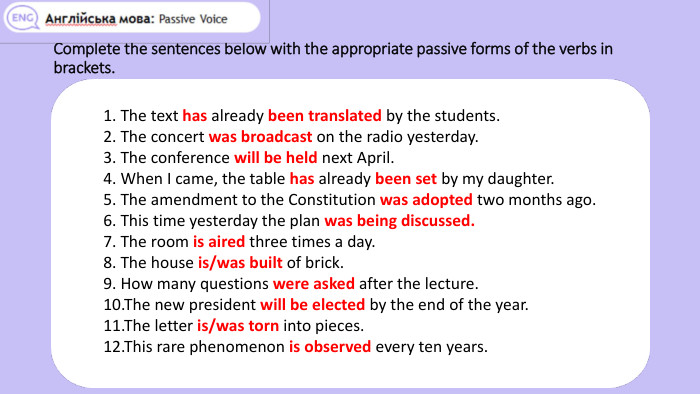
Complete the sentences below with the appropriate passive forms of the verbs in brackets. The text has already been translated by the students. The concert was broadcast on the radio yesterday. The conference will be held next April. When I came, the table has already been set by my daughter. The amendment to the Constitution was adopted two months ago. This time yesterday the plan was being discussed. The room is aired three times a day. The house is/was built of brick. How many questions were asked after the lecture. The new president will be elected by the end of the year. The letter is/was torn into pieces. This rare phenomenon is observed every ten years.1. The text has already been translated by the students.2. The concert was broadcast on the radio yesterday.3. The conference will be held next April.4. When I came, the table has already been set by my daughter.5. The amendment to the Constitution was adopted two months ago.6. This time yesterday the plan was being discussed.7. The room is aired three times a day.8. The house is/was built of brick.9. How many questions were asked after the lecture.10. The new president will be elected by the end of the year.11. The letter is/was torn into pieces.12. This rare phenomenon is observed every ten years.

13. The potatoes have already been boiled/are boiled, the meat is being roasted now.14. The baby is being looked after by the babysitter.15. Not all the disadvantages were considered carefully at the conference.16. The landscape is/has been painted very artistically.17. Children’s behaviour is influenced by the Internet.18. Fortunately, nobody was injured in the car crash.19. His ideas have been talked about by people for many years by now.20. The life boat has been called out five times for the last two months.21. A few attempts have been made so far.22. When the light was turned on, we saw a body on the floor.23. I see his attitude to life is being reviewed now.24. By next September the novel will have been written for a decade already.

Follow the strategies to be successful. Remember! Use of English (Grammar) Task 6 is a Gapped text. So this is the strategy: wherever you see a gapped text you always start with the text! 1. Reading the title2. Skimming the text3. Reading the options

Read the text below. For questions (1-6) choose the correct answer (A, B, C or D)Christmas decorations Christmas decorations date all the way back to the old Christmas markets in the 16th century in Germany. In those days, Christmas food, such as sugar rods, honey cakes, and other Christmas candy, 1) B as Christmas decorations. In 1610, tinsel was invented in Germany and 2) C from genuine silver. Machines that shredded silver into thin tinsel-sized strips were invented. However, since silver tinsel tarnishes and loses its shine over time, people eventually created artificial replacements. It 3) B that the original inventor of tinsel remains unknown. In the 18th century, many other kinds of Christmas decorations became popular. Among them were 4) C paper, and those 5) C candies, nuts, cakes, raisins and fruits. In many families, Christmas decorating traditions and decorations are passed on from generation to generation. However,Every year new decorations are purchased 6) A the old or if new inspiration is needed. {5 C22544 A-7 EE6-4342-B048-85 BDC9 FD1 C3 A}1 Aused. Bwere used. Cusing. Dhad been used2 Amade. Bdone. Cwas made. Dwas done3 Amust note. Bmust be noted. Cmust be noting. Dmust have noted4 Ahaving colored. Bcoloring. Ccolored. Dbeing colored5 Acontain. Bcontained. Ccontaining. Dwere containing6 Ato replace. Breplaced. CWill replace. Dhave replaced
 Зареєструватись за допомогою Google