
Present Tenses ( підготовка до НМТ + тести)

 Present Tenses
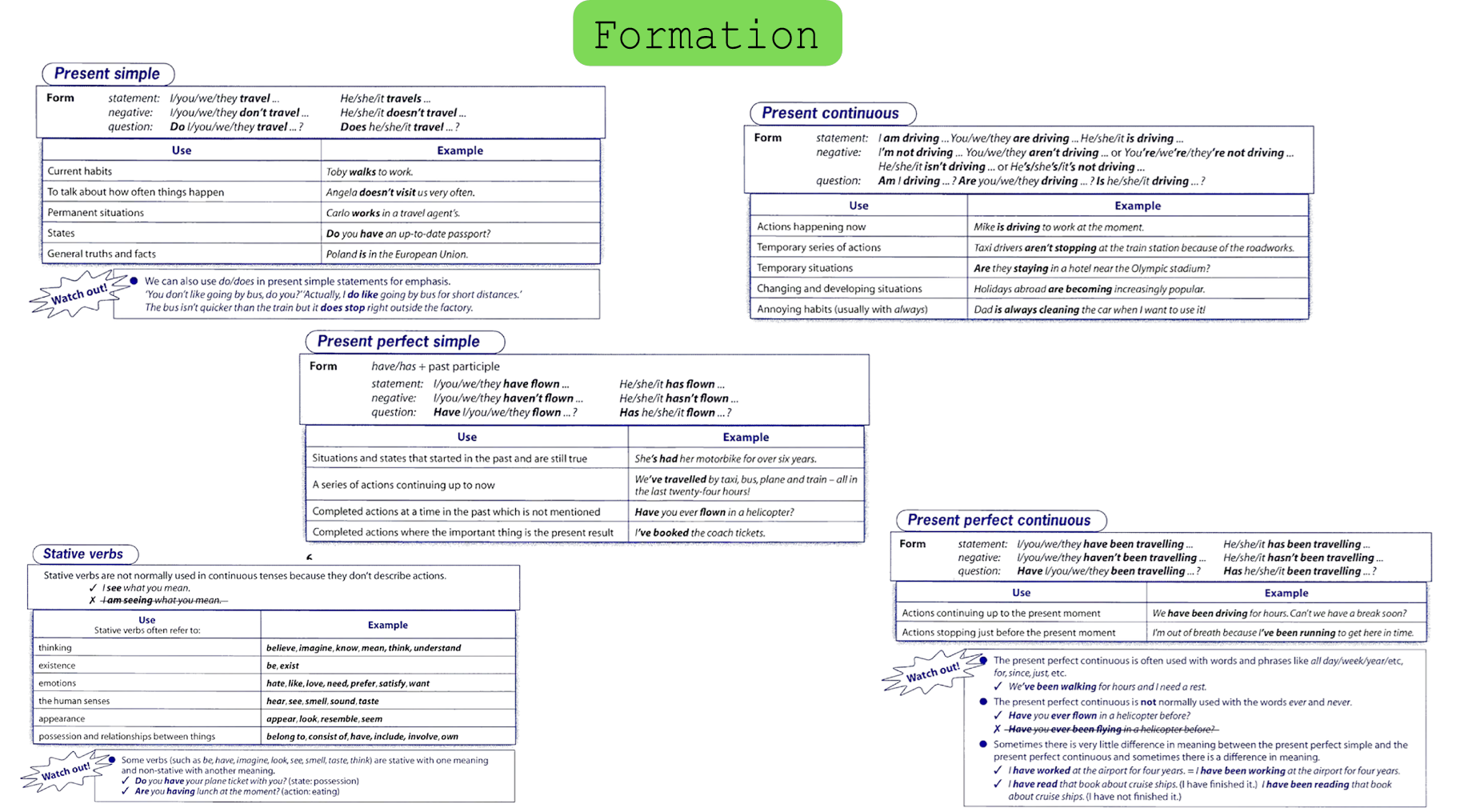
 present simple present continuous present perfect simple present perfect continuous stative verbs
soul english
|
|
Конструкція (+) |
Конструкція (-) |
Конструкція (?) |
Коротко про використання |
Приклад |
|
|
|
S + don't/doesn't + V₁ |
Do/Does + S + V₁? |
Звички, факти, розклади |
She works every day. |
|
Present Continuous |
|
|
|
Дія відбувається зараз |
She is working now. |
|
Present Perfect Simple |
S + have/has + V₃ |
S + haven't/hasn't + V₃ |
Have/Has + S + V₃? |
|
She has finished her work. |
|
Present Perfect Continuous |
S + have/has been + Ving |
S + haven't/hasn't been + V-ing |
Have/Has + S + been + V-ing? |
Дія триває певний час |
|
|
Stative Verbs |
Зазвичай Present Simple |
— |
— |
Стани, почуття, думки |
I know the answer. |


 Choose the correct answer
|
Ancient aviators? Everyone (1)___ that humans have been flying for only a few hundred years.But (2)___ it possible that ancient civilizations also had the ability and technology to fly? In the Nazcan Desert in southern Peru, there are hundreds of lines which an ancient culture drew in the dust. On the ground, they just (3)___ like straight lines. But when you (4)___ them from the air, you (5)___ exactly what they are. They are incredible and enormous pictures. The pictures (6) ___ animals, birds and symbols. One bizarre theory, which most mainstream scientists (7)___ with, is that the people who made the lines thousands and thousands of years ago flew above the lines in balloons. It (8) |
1)A knows B know C is knowing D has known 4)A see B sees C saw D seeing 7)A disagree B disagrees C is disagree D has disagreed |
2)A Is B Are C WasD be 5)A understands B understanding C understand D understood 8)A seem B seems C is seem D seemed |
3)A looks B look C looking D are look 6)A includes B include C including D included 9)A do B does C did D doing |
___ incredible, but a few people (9)___ believe it's possible.
Choose the correct answer
|
Ancient aviators? Everyone (1)___ that humans have been flying for only a few hundred years.But (2)___ it possible that ancient civilizations also had the ability and technology to fly? In the Nazcan Desert in southern Peru, there are hundreds of lines which an ancient culture drew in the dust. On the ground, they just (3)___ like straight lines. But when you (4)___ them from the air, you (5)___ exactly what they are. They are incredible and enormous pictures. The pictures (6) ___ animals, birds and symbols. One bizarre theory, which most mainstream scientists (7)___ with, is that the people who made the lines thousands and thousands of years ago flew above the lines in balloons. It (8) |
1)A knows B know C is knowing D has known 4)A see B sees C saw D seeing 7)A disagree B disagrees C is disagree D has disagreed |
2)A Is B Are C WasD be 5)A understands B understanding C understandD understood 8)A seem B seems C is seem D seemed |
3)A looks B look C looking D are look 6)A includes B include C including D included 9)A do B does C did D doing |
___ incredible, but a few people (9)___ believe it's possible.
 Choose the correct answer
1)lan ____ a shower at the moment,so could you call back in about half an hour?
A takes
B is taking
C has taken
D has been taking2)____ to Ipswich before?
A Do you ever go
B Are you ever going
C Have you ever been
D Have you ever been going
3)I ____ to all the local newspapers and TV stations to complain.
A already write
B already writing
C have already written
D have already been writing
4)____ TV for the last four hours? Turn it off and get some exercise!
A Do you watch
B Are you watching
C Watched you
D Have you been watching
5)Eric ____ hockey competitively or just for fun?
A do you usually play
B are you usually playing
C have you usually played
D have you usually been playing
6)That's the first time ____ an answer right today!
A I get
B l am getting
C I have got
D I have been getting
7)Jessica has ____ left, I'm afraid.
A already
B yet
C still
D so far
8)Dan ____ in the living room while we redecorate his bedroom.
A sleeps
B issleeping
C has slept
D does sleep
9)Unfortunately, Simone ____ a day off very often.
A doesn't get
B isn't getting
C hasn't got
D hasn't been getting
|
|

1)lan ____ a shower at the moment,so could you call back in about half an hour?
A takes
B is taking
C has taken
D has been taking2)____ to Ipswich before?
A Do you ever go
B Are you ever going
C Have you ever been
D Have you ever been going
3)I ____ to all the local newspapers and TV stations to complain.
A already write
B already writing
C have alreadywritten
D have already been writing
4)____ TV for the last four hours? Turn it off and get some exercise!
A Do you watch
B Are you watching
C Watched you
D Have you been watching
5)Eric ____ hockey competitively or just for fun?
A do you usually play
B are you usually playing
C have you usually played
D have you usually been playing
6)That's the first time ____ an answer right today!
A I get
B l am getting
C I have got
D I have been getting
7)Jessica has ____ left, I'm afraid.
A already
B yet
C still
D so far
8)Dan ____ in the living room while we redecorate his bedroom.
A sleeps
B issleeping
C has slept
D does sleep
9)Unfortunately, Simone ____ a day off very often.
A doesn't get
B isn't getting
C hasn't got
D hasn't been getting
Розбір реальних завдань НМТ
 Present Simple/Present Continuous (easy)
1 Знайдіть signal words
Signal words — ваш перший компас. Usually, always, every day, often, rarely, never → Simple. Now, at the moment, today, this week, currently → Continuous. Якщо знайшли signal word — 90% вибір зроблений, залишається перевірити тип дієслова.
2 Перевірте, чи це stative verb
Список stative verbs: know, love, hate, like, want, need, believe, understand, remember, prefer, own, belong, seem, consist of, contain, include. Якщо дієслово у цьому списку — завжди Simple, навіть якщо у реченні є «now». Приклад: I know him now (а не «am knowing»).
3 Визначте: звичка чи момент?
Запитайте: «Це дія взагалі (регулярно, багато разів) чи прямо зараз?». Для звички — Simple (I go to school every day). Для моменту — Continuous (I am going to school now).
4 Перевірте тип дії: постійна чи тимчасова
Постійна ситуація (працюю у цій компанії, живу у Києві) → Simple.
Тимчасова (живу у Києві ЦЕЙ рік, працюю над цим проєктом ЦЕЙ тиждень) → Continuous. Приклад: I live in Kyiv (постійно) vs I am living in Kyiv this year (тимчасово, потім переїду).
5 Виберіть правильне допоміжне дієслово
Для Continuous: I + am, he/she/it + is, you/we/they + are. Не плутайте am/is/are. Для Simple у 3rd person не забудьте -s (he works, не he work).
1)«My sister ___ to the gym three times a week.»
A) go B) goes C) going D) is going
1)«My sister ___ to the gym three times a week.»
A) go
B) goes
C) going D) is going
Визначте особу підмета. My sister = she (He/She/It).
Знайдіть signal word. Three times a week — маркер регулярної дії → Present Simple (не Continuous, не Perfect).
Виберіть форму дієслова. 3rd person + Present Simple → додаємо -es (бо go закінчується на -o): goes. Перевірте варіанти. A) go — неправильно для 3rd person. C) going — це V-ing, вживається з am/is/are. D) is going — Continuous, не відповідає signal word «three times a week».
2)«He ___ coffee in the morning.»
A) don’t drink B) doesn’t drinks C) doesn’t drink D) isn’t drinking
2)«He ___ coffee in the morning.»
A) don’t drink B) doesn’t drinks
C) doesn’t drink
D) isn’t drinking
 Визначте особу. He → He/She/It → потрібне doesn’t, не don’t.
Форма дієслова після doesn’t. Після допоміжного does/doesn’t — завжди базова форма V (без -s). -s переходить на doesn’t: doesn’t drink, не doesn’t drinks.
Відкиньте неправильні варіанти. A) don’t drink — потрібне doesn’t (3rd person). B) doesn’t drinks — подвійне -s (doesn’t уже містить -s). D) isn’t drinking — Continuous, контекст не вказує на момент мовлення.
3)«___ your parents speak English?»
A) Does B) Do C) Are D) Is
3)«___ your parents speak English?»
A) Does
B) Do
C) Are D) Is
Визначте особу підмета. Your parents = they (множина, не He/She/It).
Виберіть допоміжне дієслово. Для I/you/we/they у Present Simple — Do. Для he/she/it — Does. Відкиньте Continuous. Варіанти C) Are та D) Is — для Present Continuous («Are your parents speaking?»). Але питання про регулярну звичку (володіння мовою), не про момент мовлення — тому Simple.
4)«Water ___ at 100 degrees Celsius.»
A) boil B) boils C) is boiling D) has boiled
4)«Water ___ at 100 degrees Celsius.»
A) boil
B) boils
C) is boiling D) has boiled
Тип речення — науковий факт. Фізичний закон → Present Simple (не Continuous). Для фактів, наукових істин, загальновідомих правил завжди Simple.
Визначте особу. Water → He/She/It (іменник в однині) → потрібне -s.
Перевірте варіанти. A) boil — без -s, неправильно для 3rd person. C) is boiling — Continuous, значить «вода кипить зараз», не загальний факт. D) has boiled — Perfect, релевантність до моменту, не підходить.
5)«Look! The cat ___ on the tree!»
A) climbs B) is climbing C) climb D) has climbed
5)«Look! The cat ___ on the tree!»
A) climbs
B) is climbing
C) climb D) has climbed
Аналіз контексту. «Look!» — вказує на дію у момент мовлення. Кіт лізе на дерево прямо зараз, ми бачимо це.
Класичний Present Continuous.
Формула. The cat → He/She/It → is + V-ing. Climb → climbing (regular -ing).
Відкиньте варіанти. A) climbs — Simple, звичка («завжди лазить»), не підходить до «Look!». C) climb — базова форма, граматично неправильна. D) has climbed — Perfect, означає «вже заліз», але контекст — процес.
6)«I ___ what you mean now. Thanks for explaining.»
A) understand B) am understanding C) have understood D) understood
6)«I ___ what you mean now. Thanks for explaining.»
A) understand
B) am understanding
C) have understood
D) understood
 Визначте тип дієслова. Understand — це stative verb (стан розуміння). Stative verbs не вживаються в Continuous, навіть якщо є «now».
Виберіть Simple. I + understand (без -s, бо I — не He/She/It). Форма understand.

Чому не Perfect?. C) have understood — акцентує на результаті («я зрозумів»). Але тут акцент на теперішньому стані розуміння («я зараз розумію») → Simple. Хоча варіант C формально теж можливий, B) та D) точно неправильні. Чому не B або D?. B) am understanding ❌ — stative verb не вживається в Continuous (головна помилка). D) understood — Past Simple, а «now» не сумісне з Past Simple.
7)«My sister ___ with our grandmother this summer.»
A) lives B) is living C) has lived D) lived
7)«My sister ___ with our grandmother this summer.»
A) lives
B) is living
C) has lived D) lived
Аналіз контексту. «This summer» — тимчасовий період (літо, яке ще триває). «Жити з бабусею цього літа» — не постійна ситуація, а тимчасова.
Тимчасова ситуація → Continuous. Формула: she + is + living. Live тут — action verb у значенні «мешкати», можна в Continuous. Порівняння з постійною ситуацією. Якщо сестра мешкає з бабусею постійно → My sister lives with our grandmother (Simple). Але «this summer» вказує на обмежений період → Continuous.
Відкиньте варіанти. A) lives — постійна ситуація, суперечить «this summer». C) has lived — Perfect, акцентує на тривалості від певної точки до зараз (потрібно «since/for»). D) lived — Past Simple, минуле закінчене.
8)«Tom usually ___ his lunch at 1 pm.»
A) have B) has C) is having D) had
Аналіз контексту. «This summer» — тимчасовий період (літо, яке ще триває). «Жити з бабусею цього літа» — не постійна ситуація, а тимчасова.
Тимчасова ситуація → Continuous. Формула: she + is + living. Live тут — action verb у значенні «мешкати», можна в Continuous. Порівняння з постійною ситуацією. Якщо сестра мешкає з бабусею постійно → My sister lives with our grandmother (Simple). Але «this summer» вказує на обмежений період → Continuous.
Відкиньте варіанти. A) lives — постійна ситуація, суперечить «this summer». C) has lived — Perfect, акцентує на тривалості від певної точки до зараз (потрібно «since/for»). D) lived — Past Simple, минуле закінчене.
8)«Tom usually ___ his lunch at 1 pm.»
A) have
B) has
C) is having D) had
Знайдіть signal word. «Usually» — однозначний маркер Present Simple (звичка, регулярна дія).
 He/She/It. Tom → he → потрібне -s у Present Simple. Have → has (виняток).
Відкиньте варіанти. A) have — без -s, неправильно для 3rd person. C) is having — Continuous, суперечить «usually». D) had — Past Simple, несумісне з «usually» у теперішньому. Цікаво: «have lunch» — це дія (не stative verb), тому формально Continuous можливий, але не з «usually».
Розбір реальних завдань НМТ
 Present Perfect or Perfect Continuous
1 Знайдіть signal words у реченні
Ключові маркери Present Perfect: since (з моменту: since 2020, since
Monday), for (протягом: for 5 years, for 3 hours), already (вже), yet (ще — у запереченнях/питаннях), just (щойно), ever (колись — у питаннях), never (ніколи), recently, lately, so far, up to now. Якщо є один з цих маркерів — з ймовірністю 90% потрібен Perfect (а не Past Simple).
2 Перевірте: чи є зв'язок з теперішнім?
Present Perfect вживається тоді, коли минула дія релевантна зараз. Приклад: I have lost my keys (і зараз не можу відкрити двері). Якщо дія повністю у минулому, без зв’язку з теперішнім — Past Simple (I lost my keys yesterday).
3 Визначте допоміжне дієслово have чи has Просте правило: I/you/we/they → have; he/she/it → has. Для іменників: однина → has, множина → have. Не плутайте: «My parents have», але «My mother has».
4 Утворіть третю форму дієслова (V3)
Для regular verbs: V1 + ed (work →worked, play →played). Для irregular verbs: вчіть список (see → seen, go → gone, write → written, read → read, take → taken, do → done, eat → eaten).
Мінімум — 80 дієслів. Купіть картки або вивчайте по 10 на тиждень.
5 Вирішіть: Perfect чи Perfect Continuous?
Perfect — акцент на результаті, скільки закінчено (I have read 3 books). Perfect Continuous — акцент на тривалості процесу (I have been reading for 2 hours). Зі stative verbs (know, love) — тільки Perfect, ніколи не Continuous (I have known her for 5 years, не «have been knowing»).
6Перевірте відповідь підстановкою signal word
Якщо не впевнені — додайте already чи yet подумки. I have already seen this film — звучить природно, Perfect вірний. Якщо звучить дивно — можливо, треба Past Simple.
1)«I ___ my homework. Can I watch TV now?»
A) do B) did C) have done D) am doing
1)«I ___ my homework. Can I watch TV now?»
A) do B) did

 |
C) have done
D) am doing
Аналіз контексту. «Can I watch TV now?» — показує, що дія уроків щойно закінчилась і має релевантність зараз (готовий до наступної дії).
Класичний Present Perfect.
Виберіть форму. I + have + V3. Для дієслова do: V1 = do, V2 = did, V3 = done. Отже — I have done my homework.
Відкиньте варіанти. A) do — Simple, не підходить (нема signal word). B) did — Past Simple, не показує зв’язку з теперішнім. D) am doing — Continuous, означає «роблю прямо зараз», суперечить «Can I watch TV now?».
2)«She ___ in this company since 2019.»
A) works B) worked C) is working D) has worked
2)«She ___ in this company since 2019.»
 A) works B) worked C) is working
D) has worked
Знайдіть signal word. «Since 2019» — однозначний маркер Present Perfect. Слово since вимагає have/has + V3.
Допоміжне дієслово. She → He/She/It → has, не have.
Форма дієслова. Work — regular verb → V3 = worked (той самий вигляд, як V2, бо regular). Повна формула: has + worked.
Відкиньте варіанти. A) works — Simple, несумісний зі «since». B) worked — Past Simple, теж несумісний зі «since» (зі «since» завжди Perfect). C) is working — Continuous, несумісний з тривалістю «since 2019».
3)«I ___ this film yet. Let’s watch it together.»
A) don’t see B) didn’t see C) haven’t seen D) am not seeing
3)«I ___ this film yet. Let’s watch it together.»
A) don’t see B) didn’t see
 C) haven’t seen
D) am not seeing
Знайдіть signal word. «Yet» — класичний маркер Present Perfect у заперечних реченнях і питаннях. Означає «ще не». Форма дієслова. See — irregular verb: V1 = see, V2 = saw, V3 = seen. У Perfect потрібна V3.
Допоміжне дієслово. I → have (not has). Скорочення: haven’t.
Контекст. «Let’s watch it together» підтверджує, що мовець планує подивитись фільм зараз — отже, попередня дія (не побачив) релевантна зараз. Perfect вірний.
4)«My arm hurts. I ___ tennis for 2 hours.»
A) play B) have played C) have been playing D) am playing
4)«My arm hurts. I ___ tennis for 2 hours.»
A) play B) have played
 |
 C) have been playing
D) am playing
Аналіз контексту. «My arm hurts» показує наслідок тривалого процесу. «For 2 hours» — маркер тривалості. Це класичний Present Perfect Continuous — акцент на процесі, не на результаті.
Формула Perfect Continuous. S + have/has + been + V-ing. Для play: I have been playing.
Різниця з Perfect. B) have played — Perfect акцентує на кількості закінчених дій («I have played 3 matches»). Тут важлива тривалість, бо від неї болить рука. Тому Perfect Continuous.
Відкиньте Simple/Continuous. A) play — Simple, несумісний з «for 2 hours». D) am playing — Continuous, означає «граю зараз», але речення каже «рука болить після гри», тобто дія вже триває певний час.
 НМТ 2026 - демоваріант
Whether they look like us or not, most robots have three essential ingredients that (32) _______ them a robot: sensors, actuators, and programs.
A making B make C makes D is making
НМТ 2026 - демоваріант
Whether they look like us or not, most robots have three essential ingredients that (32) _______ them a robot: sensors, actuators, and programs.
A making
B make
C makes D is making
 НМТ 2024 - 2 сесія
If the kids (28) _______, mum and dad are, too.
A are happy B will be happy C were happy D happy
НМТ 2024 - 2 сесія
If the kids (28) _______, mum and dad are, too.
A are happy
B will be happy C were happy D happy
 ЗНО 2020
For the past two months, animal trainer Mark Vette
(54)_____ three dogs to drive.
A has been teaching B was teaching C taught D teaches
ЗНО 2020
For the past two months, animal trainer Mark Vette
(54)_____ three dogs to drive.
A has been teaching
B was teaching C taught D teaches
про публікацію авторської розробки
Додати розробку